Organisations invest more and more in data, but few know how to measure their data maturity
Without an internal measure of how data is managed, no organisation knows where to start improving its platforms, its processes and its data teams.
Catalogues, quality tools, cloud platforms, data teams and artificial intelligence initiatives: organisations have spent years investing in everything around data. Yet few can answer a basic question: how mature is our organisation in the way it uses data? Without that measure, every improvement is decided by intuition and nobody knows whether the investment is moving the needle. Measuring data maturity objectively, product by product, becomes the starting point for improving data platforms and everything around them.
What is data maturity?
Data maturity does not measure whether data is reliable. It measures how well an organisation manages its data and everything around it:
- Efficiency in handling data: what each product costs, how long it takes and how much manual work it needs.
- Best practices: whether they are applied consistently across every domain and team.
- Data and regulatory frameworks: whether frameworks such as DAMA-DMBOK or DCAM, and the rules that apply to each organisation, work in practice and not only on paper.
- Re-evaluation: whether you can prove an improvement worked, by measuring again after every change.
- Visualisation: whether you have the right view to act before problems appear, rather than react late.
- The business: whether the business takes part in what happens to its data and can follow it without intermediaries.
- Every country and domain: whether data maturity is visible for every country and every domain, so each one can be compared and supported.
Why does nobody manage to measure it?
For years, data maturity has been measured with manual questionnaires: a team asks itself how well it manages its data and gives itself a grade, or an external consultancy is hired. The assessment goes out of date quickly, and then it is forgotten.
Data management has also been split across domains, business units and countries, each working with its own tools: catalogue, quality, orchestration, FinOps or service management. Every tool sees its part, but none of them offers a shared view of how the whole is being managed.
Without that measure there is no starting point: you cannot tell where to invest, which improvement paid off, or how to explain it to the business. That is why measuring data maturity, continuously and product by product, is the first step.
From self-assessment to a continuous measure
For the measure to drive real improvement, it has to change shape. The unit of measure becomes the data product rather than the organisation in the abstract, so you know exactly where to act. The measure starts from what the company's tools already record and from best practices, and it covers every dimension of data maturity. And it is continuous: every improvement can be re-evaluated as soon as it lands, without waiting for the next audit.
This shift does not require replacing the catalogue or the quality tools the company already has. It requires a layer that reads from them, applies one standard across every domain and turns thousands of technical signals into a data maturity score that the board, the business and the data teams understand in the same way. That is the approach FluenBox is built on.
FluenBox: data maturity, measured and certified
FluenBox is a data maturity management platform that sits on top of the stack a company already has. It reads the reports from its tools (catalogue, lineage, data quality, job runs, data models, FinOps, service management and access) and joins them per data product in a single reporting hub. With that evidence, every product gets a data maturity score, a verifiable certification and an audit trail captured continuously. Oregon AI, the platform's artificial intelligence layer, works on top of the hub.
FluenBox works in any industry: manufacturing, banking, retail, services, energy or the public sector. By default it applies best-practice controls based on frameworks such as DAMA-DMBOK, DCAM or ISO 8000, adds GDPR controls wherever personal data is processed, and its evidence serves internal and external audit, data committees and customers who ask for assurance. For supervised institutions there is also a regulated mode, described below.
Your data tools are usually not the issue; what is often missing is a way to measure. If you do not know how well you manage your data, you do not know where to start improving, or whether what you are doing is working.
With FluenBox, every data product has an objective data maturity score, the business sees progress in real time, and every improvement can be evaluated again.
From business request to go live: the Customer 360 case
FluenBox follows every data product through its whole lifecycle. One example is Customer 360, the consolidated view of each customer:
- Request. A business stakeholder requests the product and explains what is needed, why and who will use it. The relevant data team reviews the request and approves it for analysis.
- Onboarding. Domain teams join with a RACI matrix, so every task and every approval has a clear owner.
- Strategic tasks. Teams complete a checklist per level, and the evidence arrives from the connected tools instead of being uploaded by hand.
- Assessment. Every control is mapped to the applicable frameworks and regulations, and the business owner signs off the assessment.
- Go live. The product goes to production only when its score passes the threshold the organisation sets, and it does so with its verifiable certificate.
- Monitoring. The score updates with every change; if it drops below the threshold, Oregon AI points out the gaps and tasks are reopened.
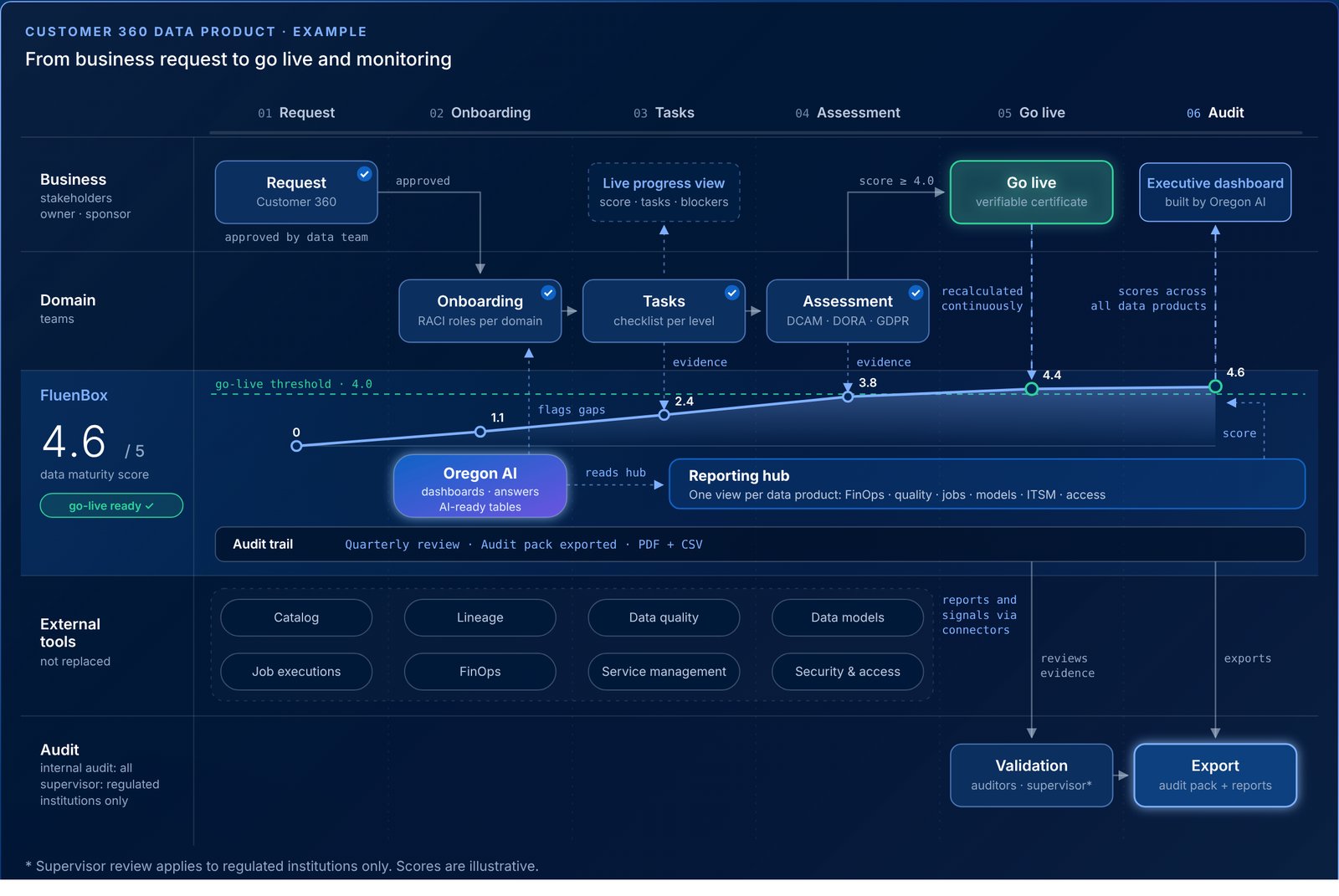
Throughout the process, business stakeholders follow progress in a live view (stage, score, blockers and pending approvals) without asking for a status report.
From each product to the strategy and the whole organisation
The score also rolls up. In FluenBox, a business strategy is a strategic product that is assessed in its own right (objectives, KPIs, sponsor and funding) and connected to every data product that makes it possible. The board sees one figure per strategy and can drill down to the specific product holding it back. A product can also be a commercial process, such as customer onboarding, assessed with the same assessments as any data product.
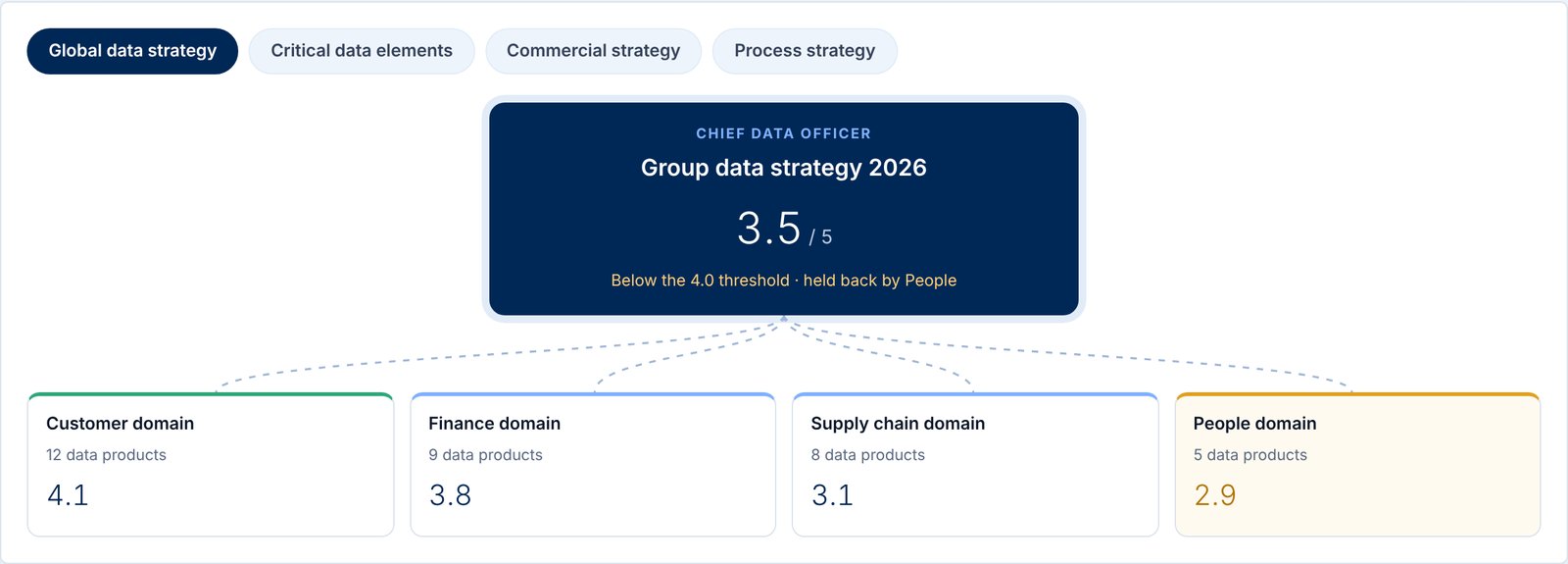
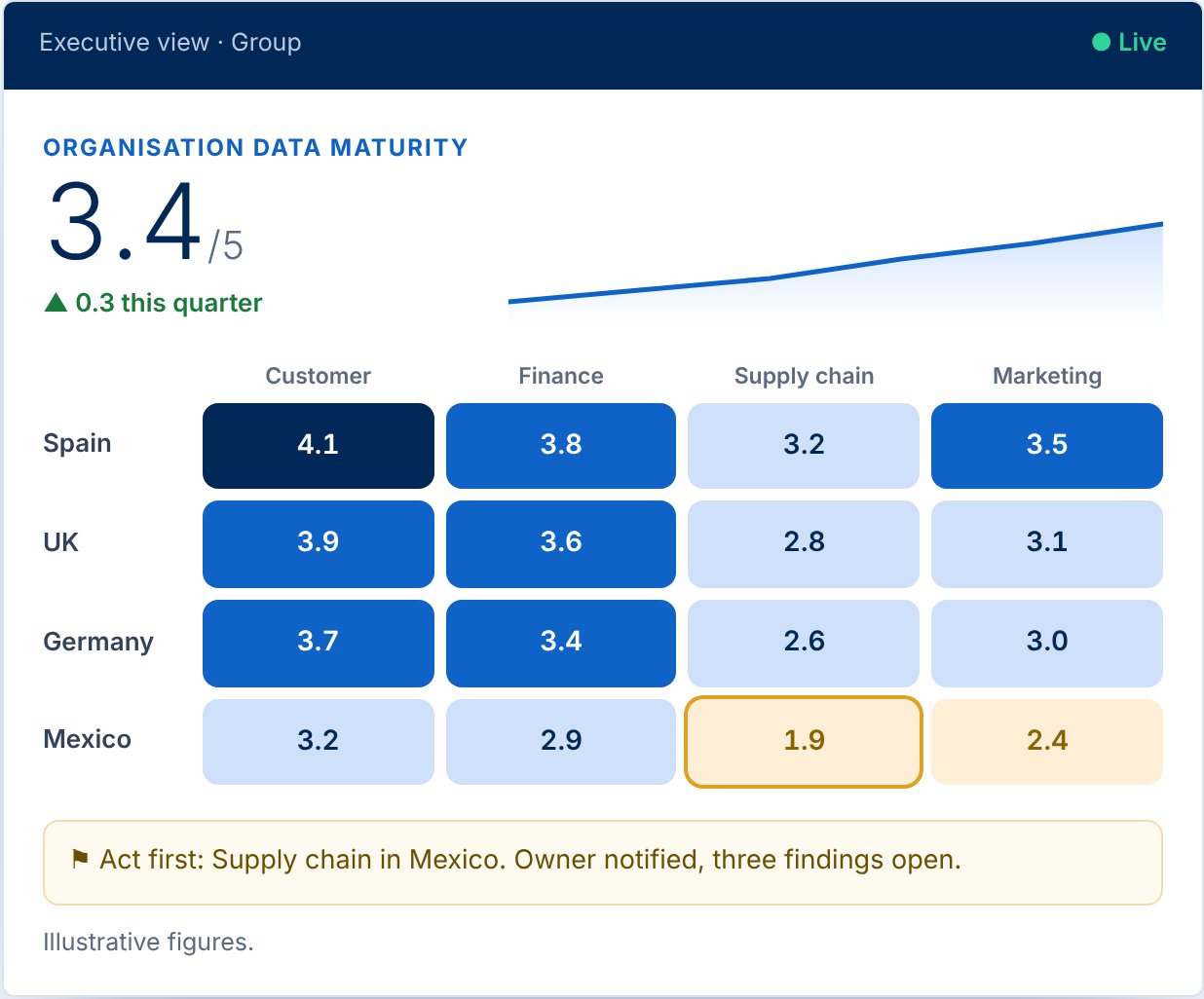
Finally, the platform groups scores by country and by business domain, and each country is measured against its own privacy rules: GDPR in the European Union, UK GDPR in the United Kingdom or LFPDPPP in Mexico. Executives see on one screen where the organisation stands, how it is moving and where to act first.
Regulated institutions and regulators
In banking, insurance and financial services, demonstrating data maturity is no longer just good practice: it is an obligation. A decade after the BCBS 239 principles on risk data aggregation were published, the Basel Committee's progress report of November 2023 found that only 2 of the 31 global systemically important banks assessed complied with all the principles. The European Central Bank published a guide with seven supervisory expectations in May 2024, has placed deficiencies in risk data aggregation and reporting among its priorities for 2024–2026, and foresees escalation measures, including capital add-ons, for serious deficiencies. Add to that the DORA Regulation, applicable since January 2025, and the EU AI Act for artificial intelligence systems.
For these institutions, FluenBox is installed in regulated mode: BCBS 239, DORA, EU AI Act and GDPR controls are switched on in every data product's plan, and the audit pack is generated ready for supervisory review. It is the only mode in which the supervisor accesses the evidence, which it can validate directly in the platform or receive as an export. The evidence is always up to date, so risk and data governance teams work on one shared record all year round, instead of rebuilding it before every inspection.
Start measuring
If your organisation invests in data but still cannot say, with a number, how well it manages it, the first step is measuring. FluenBox does it on top of the stack you already have, product by product and continuously, with a data maturity score, a verifiable certification and an audit trail ready for audit.
AI disclosure. This article was prepared with the help of AI tools and reviewed and edited by the FluenBox team, which is responsible for its content. Images and animations are illustrations, some created with the help of AI. AI transparency